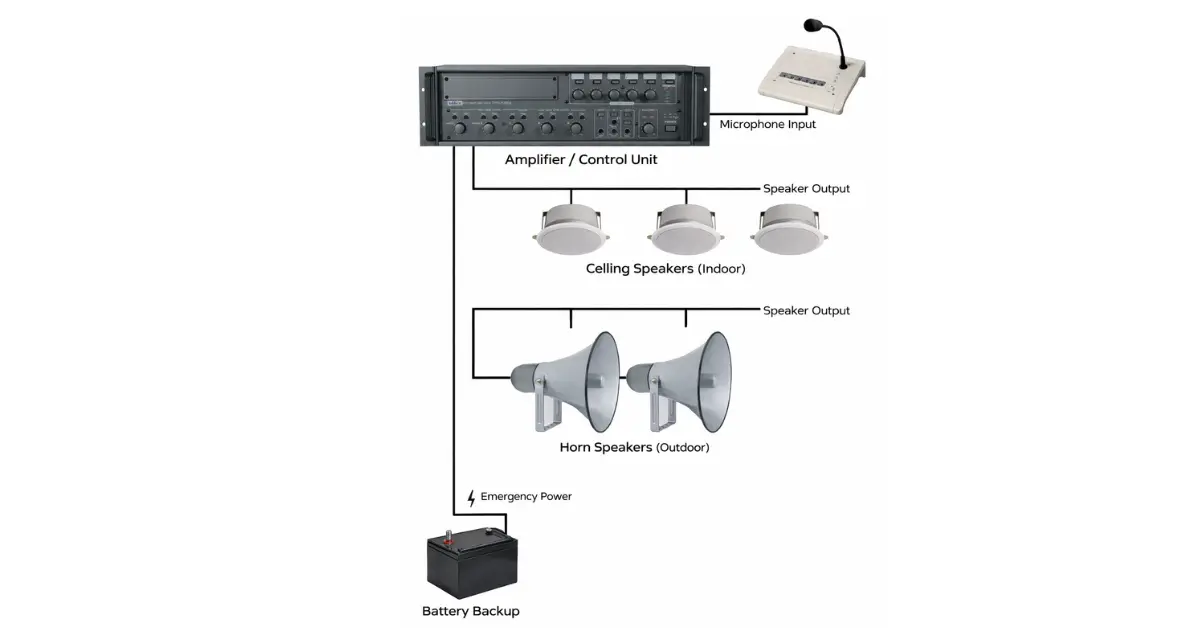
Communication is essential in today’s fast-moving world. Whether it’s a school, hospital, shopping mall, factory, office building, airport, or residential complex, the ability to deliver clear and instant messages to a large number of people is extremely important. During daily operations, announcements help maintain order and coordination. But during emergencies, communication can save lives.
This is where a Public Addressable System (PA System) plays a vital role. It is more than just speakers and microphones; it is a complete communication solution designed to broadcast clear voice messages, alerts, and instructions across a building or facility.
A well-designed public address system delivers important information quickly and clearly, without confusion or delay.
Key Takeaway Public Addressable System
• Enables fast and clear voice communication.
• Guides people safely during emergencies.
• Supports organized daily announcements.
• Covers multiple areas through zoning.
• Ensures reliability with proper maintenance and backup power.
What is a Public Addressable System?
A Public Addressable System is an electronic sound amplification and distribution system that allows voice announcements or recorded messages to be delivered to a large audience.
It typically consists of:
- Microphones
- Amplifiers
- Speakers
- Control panels
- Cabling and network connections
- Emergency backup power
The system can be used for routine announcements, background music, paging employees, or delivering emergency instructions during fire, gas leaks, or other critical situations.
In modern buildings, PA systems are often integrated with fire alarm systems and emergency evacuation systems to provide automatic voice alerts when needed.
Why a Public Addressable System is Important
Clear communication prevents panic. In emergencies, people need simple and direct instructions. A loud siren may alert people to danger, but a voice message can guide them on what to do next.
For example:
- “Please evacuate the building through the nearest exit.”
- “Do not use elevators.”
- “Remain calm and proceed to the assembly point.”
These instructions help maintain order and reduce chaos.
Beyond emergencies, PA systems improve daily operations by:
- Making staff announcements
- Calling employees or visitors
- Broadcasting important updates
- Managing large crowds
In short, a Public Addressable System supports both safety and smooth operations.
Key Components of a Public Addressable System
1. Microphones
Microphones are used to make live announcements. These can be handheld, desk-mounted, wireless, or wall-mounted, depending on the facility’s needs.
2. Amplifiers
Amplifiers increase the strength of the audio signal so it can be heard clearly across large spaces.
3. Speakers
Speakers distribute sound throughout the building. Different types of speakers are used for different environments:
- Ceiling speakers for offices
- Horn speakers for outdoor areas
- Wall-mounted speakers for corridors
- Column speakers for halls
4. Control Panel
The control panel allows operators to manage zones, adjust volume, select microphones, and activate emergency messages.
5. Zoning System
Modern PA systems enable announcements to be made in specific areas (zones) rather than the entire building. For example, a message can be sent only to the warehouse or only to the reception area.
6. Backup Power
An emergency battery backup ensures the system remains operational even during a power failure. This is especially critical in fire situations.
Types of Public Addressable Systems
Conventional PA System
Used mainly for general announcements and background music. Suitable for small offices, schools, and retail shops.
Emergency Voice Evacuation System
Integrated with fire alarm systems. Automatically broadcasts pre-recorded emergency instructions when fire or smoke is detected.
Network-Based (IP) PA System
Uses internet protocol technology for advanced control, remote management, and integration with security systems. Ideal for large facilities like airports, hospitals, and industrial plants.
Where Public Address Systems Are Used
Public Addressable Systems are widely used in many environments:
Schools and Universities
For morning assemblies, class announcements, and emergency alerts.
Hospitals
To call medical staff, manage patient flow, and provide emergency instructions.
Shopping Malls
For promotional announcements, background music, and emergency communication.
Industrial Facilities
To communicate safety instructions in noisy environments.
Offices
For paging employees and internal communication.
Airports and Railway Stations
For travel announcements and crowd management.
Wherever large groups of people gather, a PA system ensures organized and controlled communication.
Benefits of a Public Addressable System
1. Clear Communication
Ensures messages are heard clearly across all areas.
2. Improved Safety
Provides life-saving instructions during emergencies.
3. Crowd Management
Helps manage people efficiently in public spaces.
4. Time-Saving
Instant communication reduces delays.
5. Professional Environment
Creates a structured and organized communication system.
6. Integration Capability
Can be connected with fire alarms, CCTV, and access control systems for enhanced safety.
Public Address System and Fire Safety Integration
One of the most important features of a modern Public Addressable System is its integration with fire alarm systems.
When smoke detectors or heat detectors activate, the PA system can automatically:
- Stop the background music.
- Override normal announcements
- Broadcast emergency evacuation messages.
- Guide people to safe exits.
This integration creates a smarter and safer building environment.
Instead of panic, occupants receive clear voice instructions. This reduces confusion and speeds up evacuation.
Designing an Effective Public Addressable System
A properly designed PA system depends on several factors:
- Building size and layout
- Noise levels
- Number of zones required
- Indoor or outdoor coverage
- Emergency requirements
- Compliance with safety standards
Professional planning and installation ensure even sound distribution, proper volume levels, and reliable performance.
Poor installation may lead to unclear sound, feedback noise, or coverage gaps — which can be dangerous in emergencies.
Maintenance and Testing
Regular maintenance is essential to keep the system reliable.
Maintenance includes:
- Checking speakers and wiring
- Testing microphones
- Verifying amplifier performance
- Inspecting backup batteries
- Conducting emergency drills
Routine testing ensures the system works properly when it is needed most.
Modern Features in Advanced PA Systems
Today’s Public Addressable Systems are smarter and more advanced than ever.
Modern features include:
- Digital sound processing
- Remote monitoring
- Mobile app control
- Pre-recorded automated messages
- Scheduled announcements
- Integration with building management systems
- Multi-language broadcasting
These features improve flexibility and make the system easier to manage.
How Public Address Systems Support Business Growth
A reliable communication system improves productivity. Employees receive information quickly, coordination improves, and operations become smoother.
For retail businesses, promotional announcements increase customer engagement.
For industrial facilities, safety announcements reduce workplace accidents.
For corporate offices, internal communication becomes more organized.
In short, a Public Addressable System contributes to both safety and efficiency.
Choosing the Right Public Addressable System
When selecting a PA system, consider:
- Type of building
- Purpose (general use or emergency use)
- Budget
- Scalability
- Compliance with local safety regulations
Working with experienced professionals ensures proper system design and installation.
A high-quality system may cost more initially but provides long-term reliability and safety.
Common Mistakes to Avoid
- Installing low-quality speakers
- Ignoring zoning requirements
- Skipping battery backup
- Poor sound distribution planning
- Lack of regular maintenance
Avoiding these mistakes ensures better performance and safety compliance.
Future of Public Addressable Systems
The future of PA systems lies in smart integration and automation. With the growth of IoT and AI technologies, public address systems are becoming more intelligent.
They can now:
- Detect faults automatically
- Send alerts to maintenance teams.
- Integrate with smart fire systems.
- Operate remotely from control centers.
As buildings become smarter, communication systems are becoming more advanced and efficient.
Conclusion
A Public Addressable System is a reliable communication solution that ensures important messages are delivered clearly and without delay, whether for daily announcements or emergency situations. It strengthens safety, improves coordination, and helps maintain order in any building or facility. By providing clear guidance when it matters most, a well-designed PA system creates a safer, more organized, and more confident environment for everyone.
FAQ’S
It ensures fast and clear communication in both normal and emergency situations.
It provides clear voice instructions that help people respond quickly and calmly.
Yes, zoning features allow messages to be sent to selected locations.
Yes, it is designed to cover both small buildings and large complexes.
Most systems include battery backup to operate during power outages.

No responses yet